u/md0tk
REDDIT · JUNE 2026
“They literally sent my XRP to another destination tag, not my destination tag that I entered when I withdrew. Each attempt was denied while I was communicating with their support.…
ACTIVE CONSUMER WARNING · BLOCKLENDER.APP IS CURRENTLY ONLINE
DON’T SEND THEM YOUR XRP.
It promises 12% APR on your XRP. Independent security services classify it as a crypto drainer010203. Users report deposits going in and withdrawals never coming out09. It is live right now at blocklender.app.
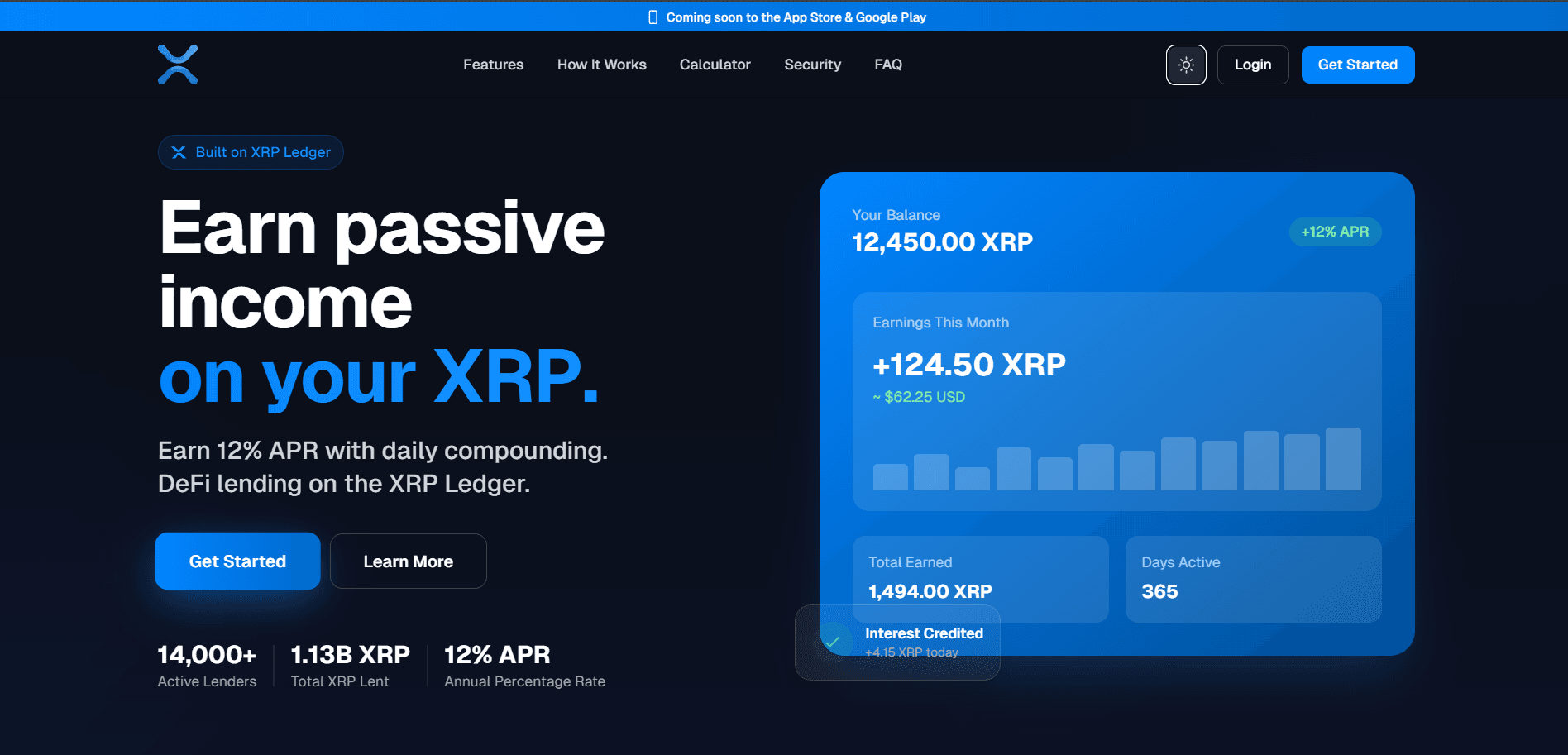
Stored locally. This page loads nothing from their domain.
THE LIVE SITE
Captured on 27 August 2026. It is polished, confident and completely unverifiable — and that combination is the whole trick.
THEY SHOW
12% APR, daily compounding
WHAT IT IS WORTH
No borrower, no collateral address and no auditor is named anywhere. Nobody can tell you where a fixed 12% return is supposed to come from.
THEY SHOW
14,000+ Active Lenders
WHAT IT IS WORTH
A number the platform publishes about itself. There is no way to check it, and no reason to believe it.
THEY SHOW
1.13B XRP Total XRP Lent
WHAT IT IS WORTH
That would be one of the largest XRP lending books in existence. Not a single wallet address is published for any of it.
THEY SHOW
A live account dashboard with balances and earnings
WHAT IT IS WORTH
It is a picture. Nothing on it is your money, your account or real data — it is a graphic on a marketing page.
THEY SHOW
Built on XRP Ledger, with XRP branding
WHAT IT IS WORTH
Anyone can build on a public ledger. It implies no endorsement from Ripple or the XRP Ledger Foundation, and proves nothing about solvency.
THEY SHOW
Coming soon to the App Store & Google Play
WHAT IT IS WORTH
An announcement, not a listing. It costs nothing to write and gives you nothing to verify.
This is the same Blocklender that collected the scam reports, the same lending pitch and the same figures — served from a new domain after the old one went dark.
THE PROOF
Not our opinion. These are independent threat-intelligence services, and every card links straight to its source so you can read the verdict yourself.
100/ 100
Classifies blocklender.io as an active crypto drainer posing as a legitimate lending platform, describing it as an elevated-risk threat built to induce wallet connections.
RETRIEVED 27 AUGUST 2026
VIEW ORIGINAL SOURCE6/ 100
Returned an extremely low trust score for blocklender.io, driven by concealed registrant identity, the age of the domain and the high-return financial offer.
READING PRESERVED FROM THE EARLIER INVESTIGATION
A reading of 0/100 has also been reported. Trust scores are recalculated over time — open the source and read the live figure yourself.
VIEW ORIGINAL SOURCE11.3/ 100
Scored blocklender.io in the very-high-risk band after evaluating its published set of 53 ranking factors.
READING PRESERVED FROM THE EARLIER INVESTIGATION
VIEW ORIGINAL SOURCE23/ 100
Gridinsoft’s online scanner has been reported returning a low-trust assessment for blocklender.io. This archive has not re-confirmed the figure directly.
NOT INDEPENDENTLY RE-CONFIRMED — VERIFY AT SOURCE
VIEW ORIGINAL SOURCEThese verdicts were issued against the Blocklender domain that collected the original scam reports. The site now running at blocklender.app carries the same name and the same offer. Open each source and check the current reading yourself.
THE METHOD
Five stages. The pattern is not unique to Blocklender, which is exactly why it is worth being able to recognise it.
Instagram accounts posing as Ripple CTO David Schwartz and CEO Brad Garlinghouse pushed the platform, using real executive photos, Ripple branding and a verification badge. Schwartz has publicly warned that anyone claiming to be him on Instagram is likely a scammer.
Sponsored articles ran on TechBullion, Bitcoin.com, IPS News and Benzinga press-release distribution. Paid placement is not journalism — nobody verified the business — but to a reader it looks like the platform was covered by the crypto press.
A fixed 12% APR, compounded daily, withdrawable at any time. Real lending pays interest because a borrower pays it. No borrower, no collateral address, no auditor and no regulator is identifiable here — so nobody can tell you where the yield comes from.
12%
FIXED RETURN
DAILY COMPOUNDING
WITHDRAW ANYTIME
Your XRP leaves your wallet and becomes a number on their webpage. On the XRP Ledger a completed payment is final: no chargeback, no reversal, no intermediary to appeal to.
YOUR WALLET
You control it
BLOCKLENDER
They control it
GONE
Destination undisclosed
Users reported withdrawals denied outright, held “under review”, and in one account settled to a destination tag they never entered — leaving a ledger record that looks like they sent the funds away themselves.
IDENTITY ABUSE
The platform did not persuade people on its own merits. Accounts wearing the identities of Ripple’s most recognisable figures did that work, and the lending link followed.0708
“Anyone claiming to be me on Instagram, Telegram, or almost anywhere else is likely a scammer.”
@ripple.cto
Reported running Stories with a "Start Lending Now" link to blocklender.io, using the Ripple brand, an executive photograph and the appearance of a verification badge. Daily crypto-news posting was used to build the profile up over time.
Recorded as active in June 2026. Not re-confirmed since. Check the platform directly before relying on this status.
@ripplecto_
Reported as a duplicate impersonation profile used to widen reach after the primary account drew attention.
Recorded as deactivated or deleted in the earlier investigation.
@bradgarlinghouse_xrp
Reported impersonating the Ripple chief executive to layer a second figure of authority on top of the CTO impersonation.
Recorded as deactivated or deleted in the earlier investigation.
@joelkatz_
Used in the earliest phase of promotion, adopting the handle Schwartz is known by on X. One community member noted at the time that both this account and another appeared verified, and said they could not tell which was genuine — which is precisely the confusion the tactic depends on.
Recorded as banned or deleted. Retained here because it appears in the earliest reports.
No account here is called fake because its username looks suspicious. Each entry rests on reported captures, and where a status has not been re-checked recently it says so rather than presenting a months-old observation as current.
VICTIM ACCOUNTS
Quoted as written, from public posts. These are allegations — consistent with each other and with the security verdicts, but not matched to on-chain records by this archive.09
$500K+
COMMUNITY-ESTIMATED REPORTED LOSSES
This figure is based on available community reports and does not represent an independently audited total. No regulator, exchange or forensics firm has published a confirmed loss figure for Blocklender.
u/md0tk
REDDIT · JUNE 2026
“They literally sent my XRP to another destination tag, not my destination tag that I entered when I withdrew. Each attempt was denied while I was communicating with their support.…
u/Sneakyone369
REDDIT · JUNE 2026
“its a scam i lost 24k. pull what you can but small amounts its a scam"
u/North-Decision-1882
REDDIT · MARCH 2026
“Ive been trying to take the small amount out and so far being denied."
u/HEATHENSCENT
REDDIT · MARCH 2026
“site only registered less than a week ago, abnormally high APR... sounds a little sus to me.…
u/OtherwiseLand6110
REDDIT · APRIL 2026
“The site is a scam. Don’t use it. If you can’t withdraw your money it’s obviously a scam."
RISK SIGNALS
A platform asking for irreversible transfers while making itself impossible to check.
Every registrant field was replaced by a privacy service. No operator, team member or company can be named.
Registered 6 March 2026. Paid promotion for a financial product began the following month.
12% APR with no lock-up and withdrawal on demand — a combination requiring evidence nobody has supplied.
Accounts posing as Ripple’s CTO and CEO drove traffic straight to the platform.
Multiple unconnected users publicly reported being unable to withdraw, including small test amounts.
PhishDestroy categorises the domain as a crypto drainer at 100/100. Others return severe low-trust readings.
Sponsored placements and press-release syndication presented as though the platform had been reported on and vetted.
14,000+ lenders and 1.13B XRP lent, on a platform that claims full on-chain transparency and publishes no addresses.
DOCUMENTED PROOF
Every record carries an evidence ID, a category, the kind of evidence it is, and a link to its source where one exists. Where this archive could not confirm something itself, the record says so on its face.
SHOWING 6 OF 15 RECORDS
COMMON QUESTIONS
The questions people ask before they deposit — and after they cannot withdraw.
Yes — that is the conclusion this archive reaches, and it is based on published evidence rather than opinion. PhishDestroy classifies the Blocklender domain as a crypto drainer with a threat score of 100 out of 100. ScamAdviser returned a trust score of 6 out of 100 and Scam Detector rated it 11.3 out of 100, both in their highest-risk bands. Multiple users have publicly reported depositing XRP and then being unable to withdraw it. Every source is linked on this page so you can check each one yourself.
blocklender.io was the original Blocklender domain. It was registered anonymously on 6 March 2026 through Namecheap, using an Icelandic privacy service that hides the registrant name, address and email. Paid promotional articles for a 12% APR XRP lending product began appearing the following month. The domain later stopped serving and returned an HTTP 403 error. Independent security services had already flagged it as malicious before it went dark.
blocklender.app is live right now and carries the same Blocklender name, the same XRP and RLUSD lending pitch, the same fixed 12% APR with daily compounding, the same claimed figures of 14,000+ active lenders and 1.13B XRP lent, and the same withdraw-anytime promise as the domain that collected the original scam reports. Nothing about the offer has changed except the web address. Treat it with the same caution.
Multiple users have publicly reported that they could not. Reports describe withdrawals denied outright, withdrawals placed under review indefinitely, and support going quiet. One user reported that their XRP settled to a destination tag they never entered, which leaves a ledger record that looks as though they sent the funds away themselves. Reports also describe small test withdrawals being refused, so a working small withdrawal should never be read as proof the platform is solvent.
No. Building on the XRP Ledger is open to anyone and implies no endorsement from Ripple, Ripple Labs or the XRP Ledger Foundation. Ripple does not endorse Blocklender. Accounts impersonating Ripple CTO David Schwartz and CEO Brad Garlinghouse were reported promoting the platform on Instagram — Schwartz has publicly warned that anyone claiming to be him on Instagram or Telegram is likely a scammer.
A 12% yield is not by itself proof of fraud — real credit businesses do earn double-digit returns. What separates them is that you can identify the operator, the borrowers, the collateral, the auditor and the regulator. For Blocklender none of those are identifiable. Interest has to be paid by somebody who borrowed the money, and Blocklender names no borrower, publishes no collateral address and names no auditor. The question is never whether the rate is too high, but who is paying it, out of what, and whether you can check.
Stop sending funds immediately, including any payment framed as a fee, tax or unlock charge needed to release your balance. Screenshot your account, the deposit and withdrawal screens and all support conversations. Copy your transaction hashes — they are permanent, public and your strongest evidence. Record destination addresses and tags. Revoke any wallet approvals you granted. Report it to the exchange you sent from, and file with IC3, the FTC or your national cybercrime portal.
Recovery is unlikely. A completed payment on the XRP Ledger is final — there is no chargeback and no intermediary who can reverse it. Report it anyway: exchanges can flag destination addresses, and reports are how patterns across many victims become visible to investigators. Be extremely careful of anyone who contacts you promising to recover your crypto for an upfront fee. Those services are frequently a second scam targeting people already harmed by the first.
No named regulator, license number, jurisdiction, auditing firm, published audit report or named insurer has been identified for Blocklender. The site displays security, insurance and audit language, but an audit that cannot be read and an insurer that cannot be named give a depositor nothing to verify.
No. Those placements are paid promotional articles and press-release distribution, not editorial reporting. Sponsored syndication involves no verification of the underlying business, and the format is deliberately designed to resemble news coverage. The Blocklender campaign ran across TechBullion, Bitcoin.com, IPS News and Benzinga press releases beginning weeks after the domain was first registered.
No audited total exists. One user publicly reported losing approximately $24,000 in XRP. Community discussion has circulated an aggregate figure above $500,000 on the reasoning that most affected people never report publicly, but no regulator, exchange or blockchain forensics firm has published a confirmed loss figure, and this archive does not present that estimate as fact.
Run the domain through PhishDestroy, ScamAdviser and VirusTotal. Check the WHOIS record for the registration date and whether the owner is hidden. Search the platform name together with the word "withdrawal" to find complaints. Demand a named legal entity, a named auditor with a readable report and a named insurer. If a platform claims full on-chain transparency, ask for the wallet addresses — a transparency claim with no addresses attached is the claim failing its own test.
Every answer above is drawn from the evidence and sources listed on this page. Where something could not be independently confirmed, the answer says so.
BEFORE YOU DEPOSIT
Any platform that cannot survive these checks does not deserve an irreversible transfer.
Ripple publishes its own products. If a yield product were affiliated, it would be documented at ripple.com or xrpl.org — not only on Instagram.
Badges are bought, transferred and faked. Two accounts in this record both appeared verified while impersonating the same person.
A financial platform should name a company, a jurisdiction and a registration number you can look up in a public register.
Lending pays interest because somebody borrows and pays it. If no counterparty can be named, ask where the yield actually comes from.
An audit means a named firm and a published report. An audit date on a landing page is a design element, not an assurance.
If coverage is claimed, a named underwriter and policy should exist. Verify it with the insurer, not with the platform.
Search the platform name alongside "withdrawal" and "cannot withdraw". Deposits are always easy. Withdrawals are where these platforms fail.
If a platform claims on-chain transparency, it must give you addresses. No addresses means no transparency, whatever the copy says.
No legitimate service ever needs them. Anyone who asks is taking your funds, not securing them.
Remote-access tools offered by "support" hand over your device and everything on it.
A single approval can authorise ongoing access to your assets. Read what you are signing.
Letting a small withdrawal through is a documented technique for building the confidence needed to secure a much larger deposit.
CHECK THE PRIMARY SOURCES
DAMAGE CONTROL
Work through these in order. The first three matter most, and the last one matters more than people expect.
Including any payment framed as a fee, tax, compliance charge or unlock required to release your balance.
Capture your account balance, the deposit and withdrawal screens, and the marketing pages before they change or disappear.
Export chat logs and take full-page screenshots with timestamps visible.
Headers carry routing information that investigators can use and that the message body does not show.
These are the strongest evidence you hold. They are permanent, public and independently checkable by anyone.
Note the exact address and destination tag for every transfer, and what the platform displayed at the time.
Revoke outstanding approvals. If a seed phrase was ever entered anywhere, move remaining assets to a newly generated wallet.
Prioritise exchange accounts and the email address those accounts recover through.
Report it immediately. Exchanges can flag destination addresses, and speed genuinely matters.
Use IC3, the FTC, or your national cybercrime portal. Reports are how patterns across victims become visible.
Post the domain, the dates and your transaction hashes. That record is what protects the next person.
Anyone promising to retrieve your crypto for an upfront fee is running a second scam against someone already hurt by the first.
SECOND-STAGE FRAUD WARNING
Crypto-recovery services demanding upfront payment are frequently a second fraud targeting people already harmed by the first. Victim lists circulate. No legitimate service guarantees recovery of assets sent on a public ledger.
OFFICIAL CHANNELS
Reports are how isolated incidents become a visible pattern. None of these organisations endorse this page.
ONE LAST THING
A polished website, a paid article, a verification badge and a large follower count can all be bought in an afternoon. None of them make a crypto platform legitimate, and none of them will get your XRP back.
VERIFY BEFORE YOU TRANSFER.
SOURCES & REFERENCES
Every citation marker on this page points to a numbered entry below.
PHISHDESTROY
Retrieved directly by this archive, 27 August 2026.
SCAMADVISER
Bot-protected. Reading preserved from the earlier investigation; verify live.
SCAM DETECTOR
Bot-protected. Reading preserved from the earlier investigation; verify live.
GRIDINSOFT
Bot-protected. Not independently confirmed by this archive.
WHOIS
Provided for the reader to run. Not reproduced here, because we have not verified it.
DAVID SCHWARTZ (@JOELKATZ) ON X
A general impersonation warning. Not a Blocklender-specific statement.